|
|
| U.S.N.B.D. - UNITED STATES - BOMBS AND FUZES; PYROTECHNICS |
| SECTION IV - PYROTECHNICS |
| PART I - AIRCRAFT PYROTECHNICS |
|
DATA: |
U.S. NAVY FLARE |
|
|
|
Mk 5 FLARE |
|
|
OVERALL LENGTH |
27 in. | |
|
DIAMETER OF FLARE CASE |
4.75 in. | |
|
WEIGHT |
18 lb. | |
|
BURNING TIME |
3 min. |
|
|
INTENSITY |
750,000 candle- |
(And Mods) |
| power | ||
|
COLOR |
Mk 5 and Mk 5 |
|
|
|
Mods 1 & 2 are | |
|
|
white; Mk 5 Mods | |
|
|
3-7, yellow. | |
|
EFFECTIVE RELEASE ALTITUDE |
3500 - 15000 ft. | |
|
TERMINAL VELOCITY (Before |
||
|
ignition) |
225 ft./sec. | |
|
RATE OF FALL (After ignition) |
450 ft./min. |
|
USE: |
|
To illuminate an area for reconnoitering, bombing, or landing. |
|
DESCRIPTION: |
|
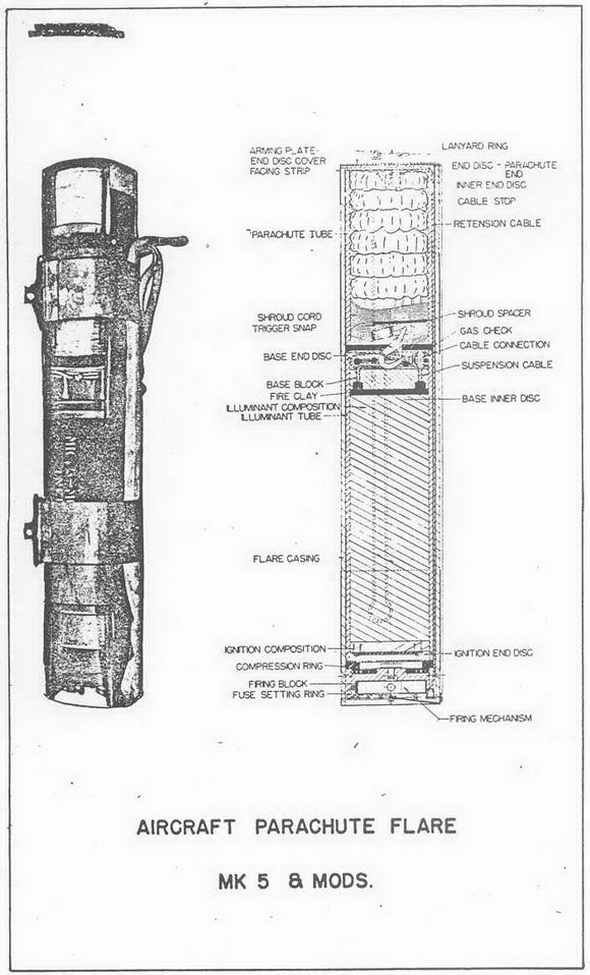
The complete flare consists of a parachute and illuminant and impregnated ship board case. It is closed on the parachute end by several layers of chipboard discs held in place by gummed cloth tape and sealed with paraffin, and on the fuze end, which contains the Ensign Bickford fuze, by a metal cover. There are two metal steadying bands fastened around the case against which the steadying forks of the bomb rack rests. The complete flare in its case is issued in a water-proof metal container. |
|
OPERATION: |
|
The setting of the Ensign Bickford time delay fuze is made by turning the lock screw on the metal firing mechanism housing to the desired delay, which is indicated on the bevel of the fuze setting ring. The numbers indicates the vertical distance the fuze will drop before iginiting. When the correct setting is obtained, the firing mechanism is se-cured the lock screw until its point is buried in the flare case. |
|
When the flare is released from the plane, the arming plate is retained on the plane, the rip cord is torn from the side of the flare case and the cover on the fuze end is flip-ped off. The rip cord is attached to the snap cord that passes around a lug on the firing lever and is secured to the fuze block. As the flare continues to fall, the snap cord is pulled, overcoming the lever spring and cocking the firing lever. When a tension of approximately 38 pounds is reached in the snap cord, it breaks releasing the firing le-ver and the lever spring then drives the firing lever back against the fulminate of mer-cury primer. The flare now falls free. |
|
The primer ignites the black powder pellets in the fuze plunger and the expending gases from the burning black powder propells the sharp point of the plunger radially outward into the Ensign Bickford time fuze. There are three small holes near the point of the plunger which allow some of the flame to escape from the inside of the plunger into the powder of the Ensign Bickford fuze that causes its iginition. The time fuses burns its predetermined length at the rate of approximately 12 inches per 60 seconds, and ignites the quickmatch under the firing block. |
|
The flash produced by the quickmatch, ignites the fire cracker fuze stapled to the ignition composition. The gases evolved when the ignition composition begins to burn force the end discs out at the parachute and then the parachute and illuminant. The parachute tube which is of split construction falls away, the parachute opens and the retention cable slides through trigger snap on the end of the shroud lines until it reach-es the cable stop. A short length of cable on one side of the cable stop suspends the flare case, and a longer length on the other side suspends the illuminant. This keeps the case from dropping as a missile hazard. The sudden shock caused by the cable stop making contact with the trigger shap is taken up by a shock absorber. This is done by pulling a cable contain lead balls called snubbers through a hole which is of smaller dia-meter than the diameter of the snubbers, and as each snubber passes through the hole, part of it is sheared off, thus absorbing part of the shock. The last ball is of much greater diameter and acts as a stop. |
|
REMARKS: |
|
In later models a new type of shock absorber eliminates the use of lead snubbers. The cable pulls through a connection in which friction absorbs the shock of the para-chute opening. |
|
|
 |