|
|
| U.S.N.B.D. - UNITED STATES - BOMBS AND FUZES; PYROTECHNICS |
| SECTION IV - PYROTECHNICS |
| PART I - AIRCRAFT PYROTECHNICS |
|
DATA: |
ARMY - NAVY SIGNALS |
||
|
|
AN-Mk 4 | AN-Mk 5 Mod 1 |
NIGHTIGHT |
|
OVERALL LENGTH |
13 in. | 19 in. | |
|
DIAMETER OF BODY |
3 in. | 3 in. | |
|
WEIGHT |
2 lb. | 4 lb. | |
|
BURNING TIME |
3-3.5 min. | 15-17 min. |
AN-Mk 4 |
|
TIME FOR IMPACT TO |
AN-Mk 5 Mod 1 |
||
|
IGNITION |
8-12 sec. |
AIRCRAFT |
|
|
EFFECTIVE RELEASE |
|||
|
ALTITUDE |
Under 500 feet | ||
|
VISIBILITY |
Night - 6 - 7 Mis. |
Mk 6 |
|
|
|
(And Mods) |
||
|
USE: |
|
To determine the drift of the plane from which is was dropped. |
|
To mark the initial point of contact with a submarine. |
|
To mark an object to which an aircraft desires to call the attention a surface vessel. |
|
To determine the wind direction before landing. |
|
To mark the landing deck on aircraft carriers for night landings. |
|
To mark the location of the surface of the water for emergency night landings. |
|
DESCRIPTION: |
|
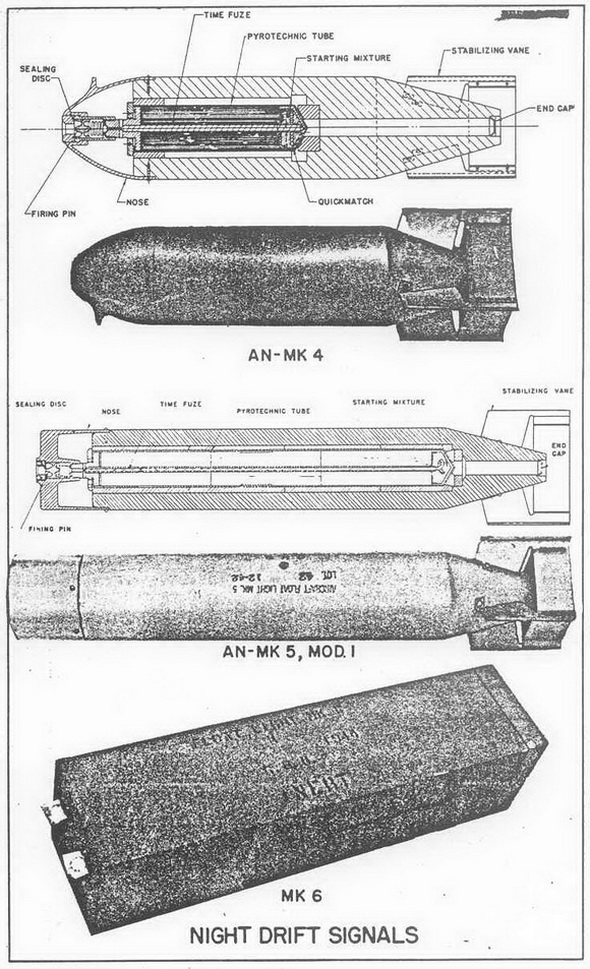
The appearance of these signals differs in that the AN-Mk 4 has an ogival shaped, die cast nose with a lug on one side side so that the signal will turn and not strike the bottom in shallow water, while the AN-Mk 5 Mod 1 has a flat die cast nose and its overall length is 6 inches greater. In both cases the die cast nose contains a water im-pact fuze. The bodies of both signals are made of hollow wooden cylinders 3 inches in diameter, with one and tapered to a one inch diameter on which the tail assembly is mounted. |
|
The pyrotechnic mixture is formed into pellets approximately four inches long and 1.25 inches in diameter with a .022 inch hole concentric with the longitudinal axis through which the delay fuze passes. One pellet is used in the AN-Mk 4 and three pel-lets are used in the AN-Mk 5 Mod 1. The pellets are enclosed in a pyrotechnic tube to keep the hygroscopic material from absorbing moisture through the wooden body. Origi-nally pure tin was used for this purpose, but in recent lots lead and zinc been substitu-ted. The nose and of the signal is closed with a paraffin treated sealing disc, while the tail is sealed with a metal cup. |
|
Aircraft Float Light, Mk 6 Mod 0 consists of four AN-Mk 5 Mod 1 drift signals which are contained in a square wooden body and burn successively. The bos is 20.25 inches long and 5.125 inches square. The weight is 15 pounds and the burning time is 45 minu-tes. The float light is released by hand from an altitude of from 300 to 5000 feet. It gives off a flame 10 or 12 inches high and grey smoke. The AN-Mk 6 Mod 2 is ignited by a pull igniter which is pulled when released. The light can be dropped from an altitude over 5000 feet. |
|
OPERATION: |
|
When launched from aircarft the drift signal falls nose down. On impact with the sur-face of the water the paraffined paper sealing disc is broken and the water drives the firing pin up against the primer. The flame from the primer ignites the time fuse which runs the length of the hole through the center of the pyrotechnic pellets and give the drift signal enough time to return to the surface and right itself. The time fuse ignites a length of quickmatch which in turn ignites the starting mixture and then the pyrotech-nic pellets. The gases evolved break open the pyrotechnic tube and force out the cap which seals the discharge tube in the tail. A bright flame 12 - 15 inches high and a white smoke are produced which are visible for six to seven miles on a clear night. |
|
REMARKS: |
|
These signals may be used for day signals but under certain conditions obversation is difficult. |
|
|
 |